Do Air Purifiers Help with Allergies? What the Science Says
Do Air Purifiers Help with Allergies? What the Science Says
Yes. Air purifiers with true HEPA filters reduce airborne allergens by up to 85%, according to the EPA. But not every air purifier on the market actually delivers that number. Most fall short, and the reason comes down to filter quality, airflow, and whether the unit can handle the size of your room.
We build air purifiers at our facility in Seymour, Connecticut. We've spent years testing filtration media, motor designs, and airflow patterns. What we've learned is that the difference between an air purifier that helps with allergies and one that just moves air around comes down to three things most buyers never check.
Let's get into it.
What Triggers Indoor Allergies
Before talking about purifiers, it helps to understand what you're actually breathing. Indoor allergens fall into a few categories, and they vary by size:
Pollen grains range from 10 to 100 microns. They drift in through open windows, on your clothes, and on your pets. During spring and fall, pollen counts inside your home can rival outdoor levels within hours of opening a window.
Dust mite waste particles sit between 0.5 and 50 microns. These are the real problem for most allergy sufferers. The mites themselves live in bedding, upholstery, and carpet, but their waste becomes airborne every time you sit down, roll over in bed, or walk across a room.
Pet dander particles range from 2.5 to 10 microns. Cat dander is especially stubborn because it's lighter than dog dander and stays airborne longer. A single cat produces enough dander to keep allergen levels elevated for months after the cat leaves a home.
Mold spores range from 1 to 100 microns depending on the species. They thrive in bathrooms, basements, and anywhere moisture collects. Unlike pollen, mold doesn't have a season. It produces spores year-round.
The common thread: all of these are airborne particles that a properly designed HEPA filter can capture.
How HEPA Filtration Actually Works
HEPA stands for High Efficiency Particulate Air. A true HEPA filter captures 99.97% of particles at 0.3 microns. That 0.3 micron number isn't random. It's called the Most Penetrating Particle Size (MPPS), the size that's hardest for any filter to catch. Particles both larger and smaller than 0.3 microns are actually easier to trap.
Here's what that means for allergies: every common allergen, from pollen to pet dander to dust mite waste to mold spores, falls well within the range a true HEPA filter captures. The filter isn't struggling to catch these particles. It's catching them easily.
The problem isn't the filter technology. The problem is everything around the filter.
Why Most Air Purifiers Underperform for Allergies
Three issues separate air purifiers that actually reduce allergy symptoms from ones that don't.
The Sealed System Problem
If the housing around your filter has gaps, air bypasses the filter entirely. It's like putting a screen door on a submarine. The filter itself might be rated at 99.97% efficiency, but if 15% of the air flowing through the unit never touches the filter, your real-world performance drops dramatically.
Budget purifiers often have loose-fitting filter compartments. You can feel air leaking around the edges when you put your hand near the seams. That leaking air carries every allergen the filter was supposed to catch.
The Airflow Problem
Filter efficiency means nothing if the unit can't move enough air. The metric that matters is Clean Air Delivery Rate (CADR), measured in cubic feet per minute. CADR tells you how much clean air the purifier actually delivers after accounting for filter efficiency and airflow.
For allergy relief, the Association of Home Appliance Manufacturers (AHAM) recommends a CADR equal to at least two-thirds of your room's square footage. A 300 square foot bedroom needs a purifier with a CADR of at least 200. Many portable units marketed for allergies have CADRs under 100.
Here's the math that matters: at 4.8 air changes per hour (the AHAM standard), a purifier processes all the air in your room roughly every 12 minutes. Drop to 2 air changes per hour, and allergens have 30 minutes to float around before the purifier catches them. That's enough time to trigger symptoms.
The Single-Filter Problem
Most purifiers under $300 use a single HEPA filter, sometimes with a thin carbon pre-filter that's barely a millimeter thick. That single filter has to do everything: catch large particles like pet hair, medium particles like pollen, and fine particles like dust mite waste.
The result? The HEPA filter clogs faster because it's handling particles that a proper pre-filter should have caught first. Filter life drops from 12 months to 4-6 months. Performance degrades between filter changes. And the thin carbon layer does almost nothing for the chemical irritants (VOCs from cleaning products, off-gassing from furniture) that can worsen allergy symptoms.
A multi-stage system handles this differently. A dedicated allergy-grade pre-filter (MERV 13 or higher) catches pollen, pet hair, and larger dust particles before they reach the HEPA filter. The HEPA filter then focuses on the fine particles it's designed for. And a substantial activated carbon filter (not a thin sheet, but pounds of granular carbon) handles gases, odors, and VOCs that irritate sensitive airways.
What the Research Shows
Multiple peer-reviewed studies support air purifier use for allergy relief:
The EPA states that portable air cleaners with HEPA filters can reduce indoor particle concentrations by 85% or more when properly sized for the room.
A 2020 study published in the Journal of Allergy and Clinical Immunology found that HEPA air purifiers in bedrooms reduced nighttime allergy symptoms and improved sleep quality in participants with allergic rhinitis.
Research from the University of California, Berkeley found that HEPA filtration reduced PM2.5 concentrations (a marker that correlates with allergen levels) by approximately 50% in real-world home environments, even with normal door and window usage.
The key finding across studies: air purifiers work best when they run continuously in the rooms where you spend the most time, especially the bedroom.
How to Choose an Air Purifier for Allergy Relief
If you're shopping for allergy relief, here's what to look for:
True HEPA certification. Not "HEPA-type" or "HEPA-like." True HEPA means 99.97% at 0.3 microns, tested and certified. Some manufacturers use H13 HEPA, which meets the European EN 1822 standard for the same level of efficiency.
CADR that matches your room. Divide your room's square footage by 1.5. The result is the minimum CADR you need. For a 450 square foot living room, you need a CADR of at least 300.
Multi-stage filtration. A pre-filter for large particles, a HEPA filter for fine particles, and activated carbon for gases and odors. Three stages mean each filter does the job it was designed for, and they all last longer as a result.
Sealed housing. Ask the manufacturer whether the filter compartment is gasket-sealed. If air can bypass the filter, the CADR rating is meaningless.
Room coverage that's honest. Some manufacturers calculate room coverage at 1 air change per hour. For allergy relief, you want 4-5 air changes per hour minimum. That means the "1,000 square foot" rating on a budget purifier might really be a 200 square foot rating at the air changes you need.
What Air Purifiers Can't Do
Air purifiers reduce airborne allergens. They don't eliminate them. Allergens settle on surfaces: bedding, carpet, countertops, clothing. No air purifier catches particles that aren't airborne.
Pair your purifier with practical habits: wash bedding weekly in hot water, vacuum with a HEPA-equipped vacuum, keep humidity below 50% to discourage dust mites and mold, and use allergen-proof covers on mattresses and pillows.
An air purifier handles what's floating in the air. You handle what's sitting on surfaces. Together, you're covering both sources.
FAQ
Can an air purifier cure allergies?
No. Air purifiers reduce exposure to airborne allergens, which can reduce symptoms. They don't cure the underlying allergy. Think of it as reducing the load on your immune system. Fewer particles in the air means fewer reactions.
How long before I notice a difference?
Most people report noticeable improvement within 2-4 hours of running a properly sized HEPA air purifier continuously. Nighttime allergy symptoms (congestion, sneezing, poor sleep) tend to improve first, especially if the purifier runs in the bedroom.
Should I run my air purifier 24/7?
Yes. Allergens don't take breaks. Pollen drifts in every time a door opens. Dust mite waste becomes airborne with every movement. Running the purifier on a lower speed continuously is more effective than running it on high for a few hours.
Do ionizers help with allergies?
Ionizers charge particles so they stick to surfaces instead of floating in the air. The problem is they can produce ozone, a lung irritant that makes allergy symptoms worse. The California Air Resources Board has raised concerns about ozone-producing air purifiers. HEPA filtration removes particles without producing any byproducts.
What about UV-C lights in air purifiers?
UV-C lights are designed to kill bacteria and viruses, not remove allergens. Pollen, dander, and dust mite waste are physical particles, not living organisms (dust mite waste is protein, not live mites). UV-C doesn't help with allergies, and it can degrade plastic filter media over time, reducing filter performance.
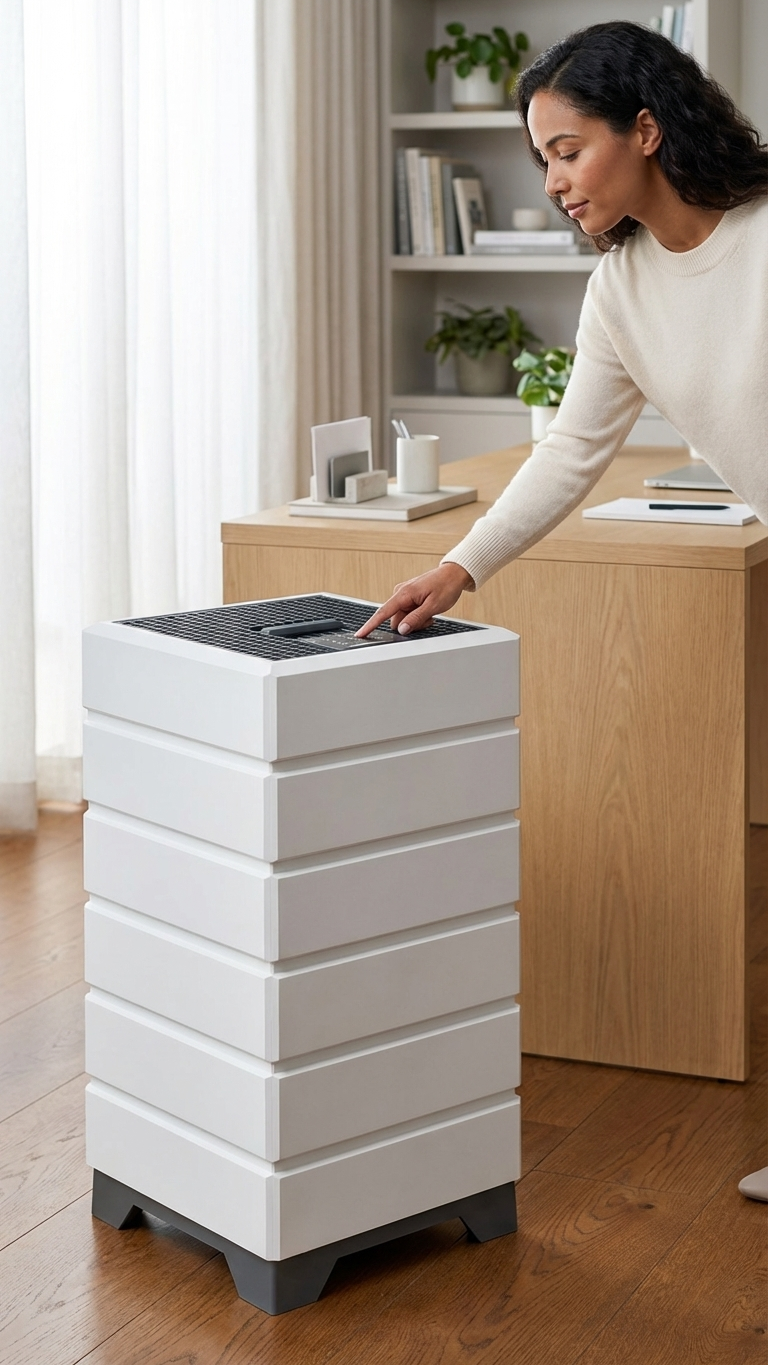
Aspen Air Purifiers are built in Seymour, Connecticut with 3-stage HEPA filtration, a German-engineered EC motor, and 1,500 sq ft coverage. Learn more at aspenairpurifiers.com