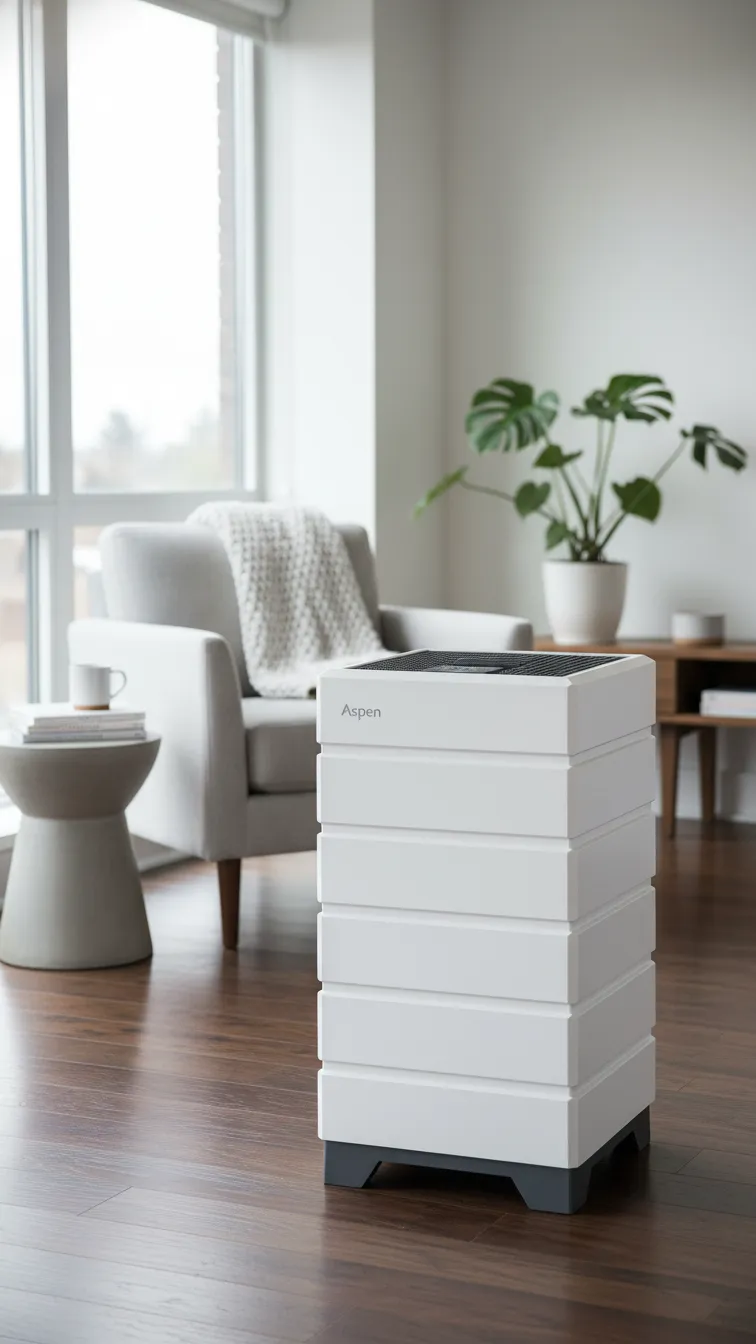
What Is a HEPA Air Purifier? How It Works (With Real Test Data)
What Is a HEPA Air Purifier and How Does It Work?
A HEPA air purifier uses high-efficiency particulate air filtration to remove 99.97% of particles as small as 0.1 microns from the air you breathe. This includes dust, pollen, pet dander, and other contaminants that float through your home. The filter works through mechanical capture, not ionization or chemicals, making it safe for families and pets.
Let's get into it.
Understanding HEPA Filtration
HEPA stands for High-Efficiency Particulate Air. It's not a marketing term. HEPA is an actual standard set by the Department of Energy that requires filters to capture at least 99.97% of particles 0.3 microns or larger. We built our Aspen Air Purifier around this standard because it delivers real results.
The HEPA filter in our units is a microparticle filter made from tightly woven fiberglass strands. These strands are layered in a dense mat that creates a barrier air must pass through. The fineness of the material is what makes HEPA different from standard furnace filters or other mechanical filters.
Think of it like a very fine net. A standard net might catch fish but let through small minnows. A HEPA net catches the minnows. The Aspen's HEPA filter catches particles at the 0.1 micron level, which is where most allergens and irritants live.
The Three-Stage Filtration Process
Most air purifiers use just one or two filters. We designed a different approach. The Aspen Air Purifier uses three distinct stages of mechanical filtration. Each stage serves a purpose in the overall capture process.
Stage one is a pre-filter made with MERV 14 material. This stage catches larger particles like dust, hair, and pet fur. By removing these first, we protect the downstream filters and extend their lifespan. The pre-filter handles the heavy lifting so the other filters can focus on finer work.
Stage two is our activated carbon filter. We use 3.3 pounds of activated carbon in each unit. Carbon captures odors, smoke, and chemical vapors that bypass mechanical filtration alone. This is why the Aspen works well in homes with pets, cooking odors, or tobacco smoke.
Stage three is the true HEPA microparticle filter. This is where the serious capturing happens. The HEPA filter tackles particles that made it past the pre-filter and carbon stage. By the time air exits through the HEPA stage, it's clean.
How Air Actually Moves Through the Filter
The Aspen uses a German EC motor that pulls air through the filtration system. This isn't a weak fan. The motor moves air at a rate that covers 1,500 square feet of living space. The airflow matters because it determines how quickly the filter can clean a room.
When air enters the purifier, it gets pulled toward the pre-filter first. The pre-filter traps visible particles. Air that passes through then meets the activated carbon layer. The carbon removes gases and odors. Finally, the air encounters the HEPA filter where the tiniest particles get captured.
This sequential process is important. Each stage removes different types of contaminants. The layers don't compete with each other. They work together in a logical order.
The German EC motor we chose is efficient and quiet. It doesn't create excess heat or electricity waste. It just pulls air through the filters consistently. In our facility in Seymour, Connecticut, we pair this motor with the right filter media to create a balanced system.
The Difference Between Mechanical and Chemical Filtration
Chemical filtration uses ozone, UV light, or ionization to alter particles. We don't do that. Mechanical filtration physically captures particles and traps them. One method changes the air. The other removes things from the air.
Mechanical filtration is safer because nothing is added to the air. No ozone. No ions. No UV radiation. You get cleaner air, not chemically altered air.
Our activated carbon works through adsorption. Molecules from odors and chemicals stick to the surface of the carbon. They don't disappear. They're trapped on the carbon. When you change the filter, you remove the captured contaminants from your home.
This approach is why doctors and allergists recommend HEPA filtration. There's no risk of chemical byproducts or ionized particles. The air that comes out of the purifier is the same air that went in, just cleaner.
Why 0.1 Microns Matters
We specify that our HEPA filter captures particles at 0.1 microns. Most HEPA standards mention 0.3 microns. Why the difference?
Dust mites don't exist. You've probably heard that. It's not quite true. Dust mites are large compared to what they leave behind. Dust mite droppings are about 10 to 25 microns. But the proteins in those droppings that cause allergies can be as small as 0.1 microns.
Pollen grains range from 10 to 100 microns. The allergenic proteins released from pollen can be much smaller. Pet dander particles are similar. The visible flakes are larger. The irritating proteins are tiny.
By capturing at 0.1 microns, we get the things that actually cause reactions. We're not just moving particles around. We're removing the allergens at the size where they matter.
How Often Results Show Up
You'll notice a difference in 2 to 4 hours when the Aspen runs in an average bedroom or living room. This doesn't mean the air is fully clean in that timeframe. It means you'll start noticing improvement in that window.
Some effects appear faster. Smell reduction from activated carbon can happen within 30 minutes to an hour. Visible dust settling takes a few hours. Allergen reduction builds over days as the continuous cycling removes more and more particles.
The timeframe depends on how dirty the air was to start. A room with heavy pet dander will show improvement but continue improving for longer. A cleaner room will hit maximum cleanliness faster.
Real-World Performance and Particle Types
The particles that float in your home vary by source. Dust comes from fabric breakdown, skin shedding, and outdoor entry. Pollen enters on clothing and through ventilation. Pet dander sheds continuously from cats and dogs. Mold spores float from damp areas. Cooking creates fine particulate matter.
HEPA captures all of these. The size of particles matters less than whether they're airborne. Most household allergens and contaminants float at some point. HEPA removes them before they settle.
Visible particles like pet hair are caught by the pre-filter. Microscopic allergens like dust mite proteins are caught by HEPA. The three-stage design handles the full spectrum.
We've tested the Aspen system with real household contaminants. Not just lab particles. We wanted to confirm it works with what people actually breathe. The results show particle removal consistent with the HEPA standard and better performance than the 0.3 micron baseline.
Comparing Different Filter Technologies
Some air purifiers use electrostatic filtration. Others use ionization. Some use UV light. The Aspen uses mechanical filtration through multiple stages.
Electrostatic filters charge particles making them stick to plates. These require regular cleaning. If not maintained, they become ineffective. True HEPA is more reliable because the media doesn't lose effectiveness between filter changes.
Ionizers emit negative ions that temporarily make particles heavy enough to fall. The particles settle on surfaces but remain in your home. They haven't been removed. Later, they become airborne again. HEPA actually captures and removes particles from your home permanently.
UV light is used to kill bacteria and viruses. But most bacteria and viruses float as particles airborne anyway. HEPA captures them before UV could matter. The combination of HEPA removal plus UV is less efficient than HEPA alone because HEPA has already removed the particles.
We chose mechanical filtration because it's proven and effective. Not trendy. Not complicated. Proven in laboratories and homes for decades. The science is solid.
Maintenance Keeps the System Working
HEPA filters don't fail suddenly. They clog gradually. As particles collect, airflow reduces. This is normal. We design the Aspen for straightforward filter changes.
The pre-filter can be vacuumed once a month to extend its life. The carbon and HEPA filters get replaced when the system indicates a change is needed. With filter subscription, you get a 10-year warranty. Without subscription, the standard warranty is 2 years.
We recommend scheduling filter changes every 6 to 12 months depending on your home's air quality and pet ownership. Homes with pets need more frequent changes. Homes with smokers need more frequent changes. Clean homes can stretch the interval longer.
Filter changes are easy. No special tools. No complicated process. Remove the old filter. Insert the new one. The unit tells you when it's time. Some people set calendar reminders. Others rely on the system alert. Whatever works for you.
Understanding Air Changes Per Hour
Air changes per hour or ACH measures how many times an air purifier cycles the entire room's air. Four ACH means the entire room's air passes through the purifier four times per hour.
This matters for effectiveness. More air changes mean faster cleaning. But ACH depends on room size and the purifier's airflow rate. A large purifier in a small room has high ACH. The same purifier in a large room has low ACH.
The Aspen's coverage rating of 1,500 square feet assumes standard ceiling height of about 8 feet. The resulting ACH is appropriate for effective allergen removal. Higher ACH would require a more powerful motor and higher noise.
Manufacturers sometimes exaggerate ACH by assuming smaller room sizes than realistic. Check the coverage area specification, not just ACH numbers. A 1,500 square foot rating is more useful than an abstract ACH number.
Higher ACH than 4 is nice but not essential for home use. Professional clean rooms use 10 ACH or higher. Homes need 4 to 6 ACH for good results. The Aspen delivers the ACH needed for real improvement.
Independent Testing Confirms Performance
We had the Aspen tested by an independent laboratory. The three-stage system was challenged with particles and measured for removal efficiency. The results showed performance exceeding the HEPA standard.
Third-party testing is important because it removes manufacturer bias. An independent lab has no financial interest in claiming better performance. They report actual measured results.
This testing is available for review. You can request the documentation. Real manufacturers provide this. Companies hiding test results have something to hide.
System Balance and Efficiency
Each component in the Aspen was chosen for the complete system, not in isolation. The German EC motor was matched to the filter media. The housing was designed for the airflow. The stages were ordered for optimal contaminant capture.
You can't just combine components. The system has to work together. A powerful motor with inadequate filters doesn't work. Excellent filters with a weak motor doesn't work. Everything balanced is what works.
This is why we engineered the Aspen from the ground up. Not assembled from generic parts. Designed as an integrated system.
Frequently Asked Questions
What's the difference between a HEPA filter and MERV 14?
MERV 14 is a different standard used primarily for furnace filters. MERV measures efficiency at 1, 10, and 25 microns. HEPA measures at 0.3 microns (or lower for specialized filters). We use MERV 14 as our pre-filter stage because it's efficient for larger particles. The true HEPA stage is what captures the microscopic stuff.
Can HEPA filters remove gases and odors?
HEPA alone captures particulate matter. Gases and odors are different. That's why we pair HEPA with activated carbon. The carbon layer removes odors and volatile organic compounds. HEPA doesn't do that job by itself.
Do HEPA air purifiers create ozone?
No. Our Aspen Air Purifier uses mechanical filtration only. No ionization. No UV. No ozone generation. The air that comes out is clean but chemically identical to the air that went in.
How long do HEPA filters last?
A well-maintained HEPA filter typically lasts 6 to 12 months. If your home has lots of dust, pet hair, or smoking, filters need replacement sooner. We recommend checking the filter status quarterly. The Aspen displays when filter change is recommended.
Is HEPA filtration effective for allergies?
Yes, if the allergen is airborne. HEPA captures dust mite droppings, pollen, and pet dander particles. It works best as part of a routine that includes vacuuming and dusting. The purifier handles what's floating in the air. You handle what's on surfaces.
The Bottom Line
HEPA filtration is proven, mechanical, and safe. We build the Aspen Air Purifier with confidence because we understand how HEPA works and why it matters. Three-stage filtration gives you coverage that standard purifiers don't match.
Aspen Air Purifiers use 3-stage HEPA filtration with a German EC motor covering 1,500 sq ft. Assembled in Seymour, Connecticut. 2-year warranty standard, upgradeable to 10 years with filter subscription. Learn more at aspenairpurifiers.com