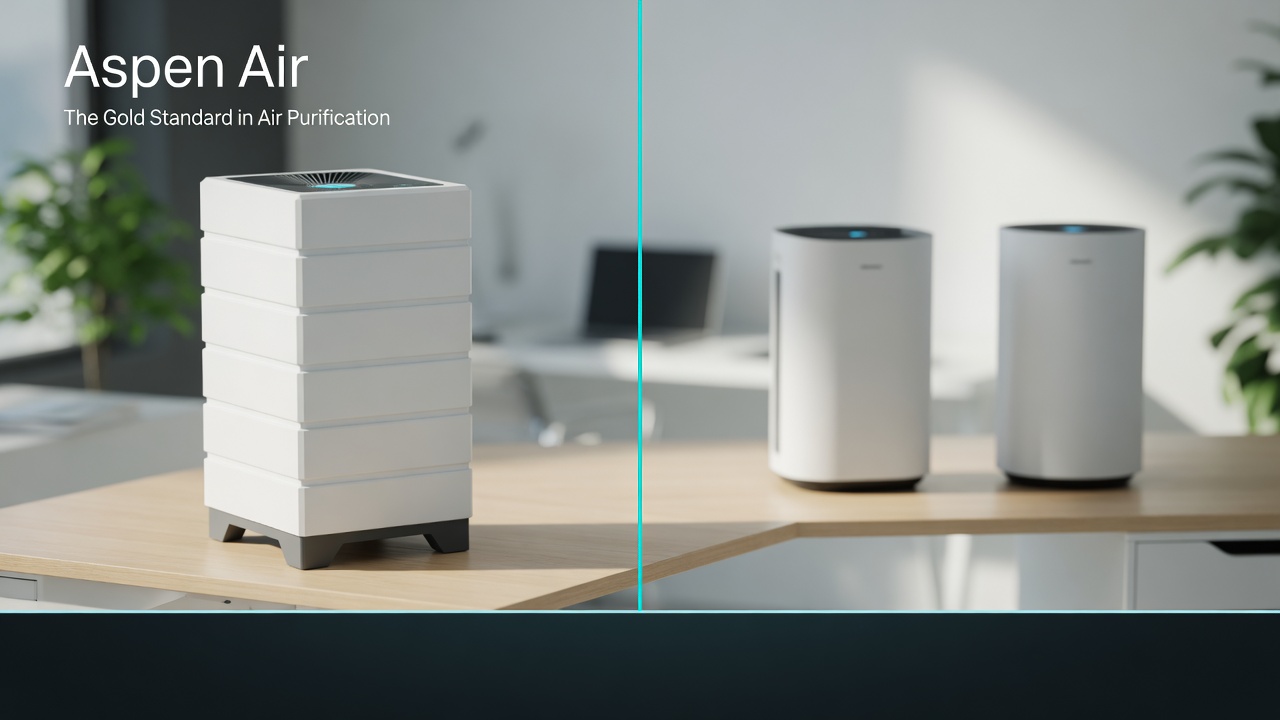
Aspen Air Purifier vs Dyson vs IQAir: Which HEPA Purifier Is Worth It in 2026?
Aspen vs Dyson vs IQAir: which air purifier actually delivers?
If you are comparing premium air purifiers, you have probably narrowed it to a few names: Aspen, Dyson, and IQAir. All three cost serious money. All three claim strong filtration. The engineering differences are significant, and they affect whether you notice a real improvement in air quality, allergies, smoke, and everyday comfort.
This is a practical, spec-by-spec comparison based on published product positioning and real-world use. It also explains why many homeowners buy the Aspen from a dedicated dealer with free shipping and a live savings offer.
Looking for more savings and fast shipping?
Aspen Air Purifier — $1,649. Free shipping · ships today*. Sign up on-site for another $149 off.
How Aspen works · Genuine filter sets
*Contiguous USA. Daily shipping cutoff times apply.
Quick specs comparison
Competitor prices and specs are approximate retail ranges and can change. Always verify current manufacturer claims for the exact model you are considering.
Filtration performance
All three use HEPA-grade filtration. The implementations still differ in ways that show up in a large room.
The Aspen uses a dedicated 3-stage system: an allergy pre-filter catches large particles before they load the HEPA stage, an H13 HEPA stage handles fine particles, and a substantial activated carbon stage handles gases and odors. Sealed housing is designed for zero bypass so air is forced through the media. CADR of 442 CFM pollen and 373 CFM smoke puts Aspen in a high-airflow residential class.
Dyson uses H13 HEPA with a sealed system and adds a catalytic path aimed at formaldehyde. That formaldehyde path is genuinely interesting for new homes and furnishings. Coverage claims can be harder to compare apples-to-apples when independent CADR-style numbers are thin or self-reported.
IQAir is famous for HyperHEPA-class particle capture, including very small particles. For ultrafine particle focus, IQAir has a strong technical reputation. Airflow aggressiveness and whole-room air changes still matter for large open spaces. Check specs against your actual room size.
Room coverage and airflow
This is where many homeowners choose Aspen. At about 1,500 sq ft coverage with high CADR, the unit is built for large living areas where you want real air changes: fewer lingering allergens, faster smoke clearance, and air that many users say feels different within a few hours of continuous run time.
Dyson-class coverage often sits closer to ~1,000 sq ft marketing claims. IQAir HealthPro-class units are excellent particle machines, but large great rooms still need honest sizing.
Energy, noise, and daily living
Aspen’s German EC motor is designed for continuous duty with lower energy draw than many AC motors and quiet low-speed operation. That matters if the unit runs 24/7 in a bedroom or open living space.
Dyson often wins on furniture design and app ecosystem. IQAir often wins for buyers who prioritize particle pedigree and clinical-adjacent brand reputation. Aspen wins for buyers who want high CADR + large coverage + USA assembly + straightforward filter ownership.
Cost of ownership (not just sticker price)
Aspen: $1,649 list · genuine filter set about $288/year class (or protection-plan options if you choose them carefully).
Dyson: lower entry price on some models · multi-part filters can add up over time.
IQAir: premium entry · multi-stage filter replacements can be significant over years.
If you keep a purifier for 5–10 years, filter cost and energy matter as much as day-one price.
Buy Aspen from Aspen Air Purifiers
You are not buying a mystery marketplace listing. You get the real Aspen unit, free shipping, ships today* when ordered by cutoff, and a site signup for another $149 off.
Already own an Aspen? Shop filter sets · How Aspen works
*Contiguous USA. Cutoff times apply.
Who should buy which?
Choose Aspen if you want high CADR, large-room coverage, USA assembly, and a serious 3-stage system for home or office, plus dealer fulfillment (free ship / ship today).
Choose Dyson if design, app features, and formaldehyde-focused marketing matter more than max room airflow.
Choose IQAir if HyperHEPA particle reputation is your primary decision driver and you accept multi-stage filter costs.
FAQ
Is the Aspen really $1,649?
Yes. Current list price on our store is $1,649. Site signup can unlock another $149 off. Confirm at checkout.
Does Aspen ship free?
We offer free shipping and same-day ship messaging for qualifying US orders when ordered by 12:00PM EST Daily cutoff.
What are Aspen’s CADR numbers?
442 CFM pollen and 373 CFM smoke. Those matter for large rooms and for smoke-heavy days when you need real air turnover.
Can I buy filters later?
Yes. Genuine Aspen filter sets are available on our site. That is important for long-term performance.
Is Aspen the same as Elemental Air Systems?
Aspen is the high-performance purifier associated with Elemental Air Systems manufacturing. We sell as a dealer-focused storefront with fulfillment and support oriented to homeowners who want clean air without the runaround.
Bottom line
Dyson and IQAir are real competitors with real strengths. For many homes that need serious airflow and coverage, Aspen’s CADR and 1,500 sq ft class design are the reason people stop comparing and start breathing easier.
Ready for hospital-grade air at home?
Aspen Air Purifier — $1,649. Free shipping · ships today*. Sign up for another $149 off.
Shop genuine Aspen filter sets · How Aspen works
*Contiguous USA. Cutoff times apply.
Order the Aspen Air Purifier · See how Aspen works · Medical-grade vs consumer purifiers · Best purifier for wildfire smoke