Best Air Purifier for Dog Allergies: What to Look For
If you're allergic to your dog, you've probably heard the usual advice: get a "hypoallergenic" breed, or give the dog up. Most people want neither. They want to keep the dog and breathe easier at home.
An air purifier can be part of that plan. It isn't magic, and it isn't medicine. This guide covers what dog allergen actually is, what a good air purifier can and can't do about it, which specs matter, and how to set up your home so the purifier does its best work.
Quick note: We sell air purifiers, not medical advice. If your symptoms are moderate or severe, or you have asthma, talk with a board-certified allergist. They can test which dog allergens you react to and build a plan with you.
What you're actually allergic to (hint: it isn't the fur)
People say "I'm allergic to dog hair," but the hair is mostly the delivery truck. According to the Asthma and Allergy Foundation of America (AAFA), pet allergy is a reaction to proteins found in a pet's dander (dead skin cells), saliva and urine. The fur collects those proteins, and it can also carry other allergens like dust mites, mold and pollen. [1]
The American Academy of Allergy, Asthma & Immunology (AAAAI) lists several known dog allergens, named Can f 1 through Can f 6, found in things like dander, hair, saliva and urine. [2] Can f 1 is the best known.
Here's why that matters for air cleaning:
- Dog allergen gets into the air and stays there. AAFA notes that allergens become airborne when you pet or groom an animal, get stirred back up by dusting and vacuuming, and can then stay in the air for long periods. [1]
- Some of it rides on very small particles. A study of homes with dogs found most airborne Can f 1 on larger particles, but about 20% was on small particles under 5 microns. The researchers noted that particles that small are expected to stay airborne for a long time. [3]
- It settles everywhere. AAFA notes pet allergens stick to walls, furniture, carpets, pillows and clothing, and can stay at high levels for months. [1]
So there are two jobs: catch what's floating in the air, and cut down what's settled on surfaces. An air purifier handles the first. Cleaning habits handle the second.
"Hypoallergenic" dogs: what the allergists say
If you're thinking about a new dog, this part's for you. Both AAAAI and the American College of Allergy, Asthma and Immunology (ACAAI) say a truly allergy-free dog breed doesn't exist. [2][4] ACAAI points to a study comparing homes with so-called hypoallergenic breeds against homes with other dogs. Dog allergen levels in the two groups were no different. [4]
Individual dogs can vary, and some people tolerate one dog better than another. AAAAI notes, for example, that some people who react only to Can f 5, an allergen from intact male dogs, may do fine with female or neutered male dogs. [2] An allergist can test for that. The takeaway is that a breed label isn't a plan. Your home setup is.
What an air purifier can (and can't) do for dog allergies
What the evidence shows: In a small study of nine homes with dogs, running a HEPA air cleaner lowered airborne Can f 1. With the dog in the room, levels fell about 75% from baseline on the days the cleaner ran, and there was no significant drop on control days. With the dog elsewhere in the house, the drop was about 90% on active days, compared with a smaller drop on control days. [5]
That's a real result, and it's a result about allergen in the air. It's a small study, and it measured air, not symptoms.
What allergy groups recommend: AAFA suggests using an air cleaner with a HEPA filter at least four hours a day, especially where people sleep. [1] ACAAI says HEPA cleaners run continuously in a bedroom or living room can reduce allergen levels over time. [4]
What a purifier can't do:
- It can't pull allergen out of your couch, carpet or bedding. That's a cleaning job.
- It can't change how your body reacts. That's a conversation with your allergist.
- It can't fix the problem by running for an hour after you vacuum. Your dog makes new dander every day, so the purifier needs to run every day.
What to look for in an air purifier for dog allergies
Most pet-purifier roundups say "get HEPA" and stop there. Here's the fuller checklist, in plain English.
1. True HEPA, in a sealed path
HEPA is the filter that does the fine-particle work. Look for "True HEPA" with a stated efficiency, not "HEPA-type" or "HEPA-like." Just as important, the air has to go through the filter, not around it. (More on this in our guide to True HEPA vs. HEPA-type vs. ionizers.)
2. A real pre-filter for hair
Dog hair and big debris clog a HEPA filter fast. A good pre-filter catches the big stuff first, so the HEPA stage keeps doing its job longer.
3. Enough airflow for the room you live in (CADR)
CADR (Clean Air Delivery Rate) tells you how much cleaned air a unit delivers. Compare the pollen and smoke numbers between brands. A unit with a small CADR in a big open living room will always be playing catch-up.
4. Built to run all day
Because dog dander keeps coming, look for a unit you're happy to leave on: quiet at lower speeds, efficient to run, and with several fan speeds so you can turn it up after grooming or vacuuming.
5. Zero ozone, no ionizer tricks
Some purifiers add ionizers or ozone generators. Ozone irritates the lungs, which is the last thing an allergic household needs. Mechanical filtration (filters and a fan) is the straightforward route.
6. Carbon, if odor matters too
Carbon doesn't do much for allergen particles, but it does adsorb odors and gases. If you're also fighting "wet dog" smell, see our pets guide to dander and odors.
7. Filters you can actually keep up with
A clogged filter is a weak filter. Know the replacement schedule and cost before you buy.
How to set up your home if you're allergic to your dog
The purifier works best as one piece of a simple routine. These come straight from AAFA's and ACAAI's guidance for pet allergies: [1][4]
- Make the bedroom a dog-free zone and keep the door closed. You spend a big part of every day there.
- Put the purifier where you spend the most time. For most people, that's the bedroom at night or the main living area during the day. ACAAI specifically mentions the bedroom or living room. [4]
- Keep the dog off fabric furniture, or use washable covers and wash them weekly in hot water.
- Vacuum weekly with a HEPA vacuum, and dust hard surfaces with a damp or microfiber cloth so dander doesn't go back into the air.
- Bathe the dog weekly. ACAAI says weekly baths can reduce airborne dog allergen. AAAAI notes the benefit is short-lived, with levels returning to baseline within two to three days, so it works best as a habit. [2][4]
- Let someone without allergies do the brushing, outside if possible.
- Wash your hands after petting, and change clothes after a lot of close contact if you're very sensitive.
- Upgrade your HVAC filter. AAFA notes forced-air systems can spread allergens and suggests HEPA or certified filters in central heating and air. [1]
Where Aspen fits
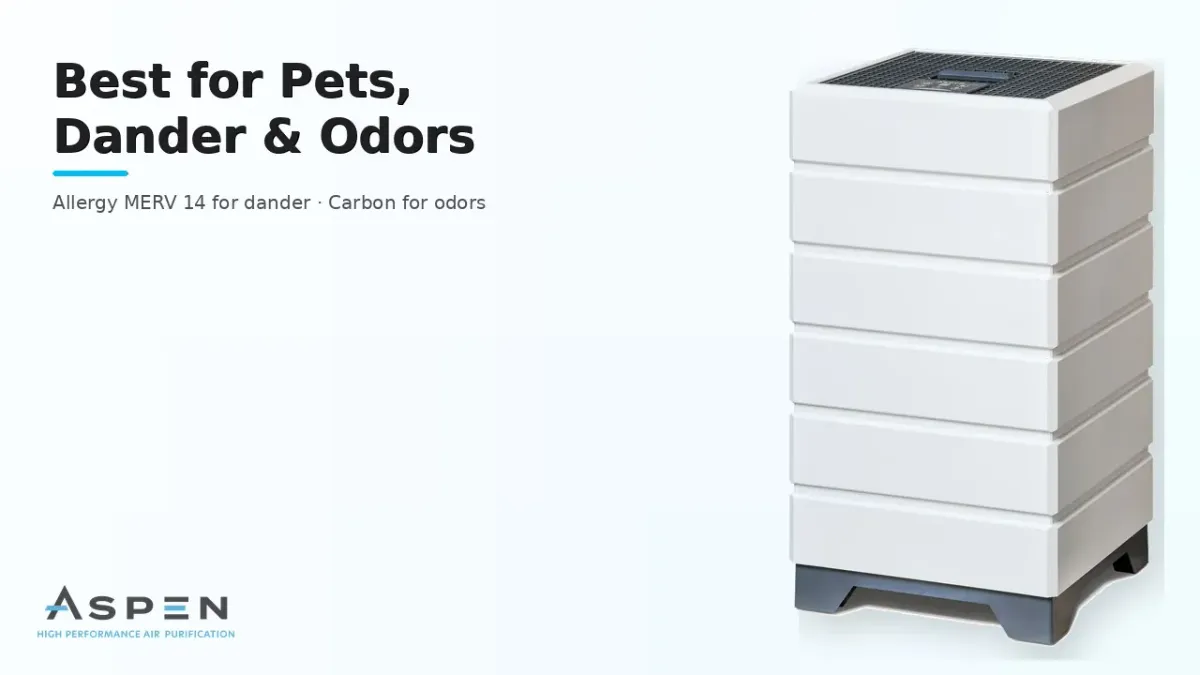
We built the Aspen Air Purifier for people who want one serious machine they can leave running in the rooms they actually live in. Here's what it is, straight from our product page and How Aspen Works:
- Three-stage filtration: a MERV 14 pre-filter for hair, dust and dander; 3.3 lbs of activated carbon for odors and VOCs; and a True HEPA filter rated at 99.97% of particles at 0.1 microns
- AHAM CADR: 442 CFM (pollen), 373 CFM (smoke)
- Coverage: up to 1,500 sq ft
- Zero ozone. No ionizers. No UV. Mechanical filtration only.
- German EC fan motor with 6 speed settings, built to run quietly around the clock
- No WiFi or Bluetooth, so there's no data collection
- Designed and assembled in Seymour, Connecticut, with a 2-year manufacturer warranty
- Filter sets last about a year under normal conditions. Here's our filter replacement guide, and you can order genuine filter sets anytime
Price and policies:
- $1,649
- Free shipping on single units to the contiguous lower 48 states
- 30-day returns. See our Return Policy for the details.
Is Aspen the right call for every dog owner? No. If you only need to clean a small spare room, a smaller unit may be all you need. Aspen makes sense when dog allergen is a daily, whole-living-space problem and you want a single unit to run all day in the rooms you share with your dog.
Questions first? Call us at 814-Pure-Air (814-787-3247).
FAQ: air purifiers and dog allergies
Will an air purifier get rid of my dog allergy?
No. An air purifier doesn't change your allergy. What a True HEPA purifier can do is lower the amount of dog allergen floating in the air, which a home study measured with a HEPA air cleaner running. [5] Pair it with the cleaning steps above, and talk with an allergist about your symptoms.
Where should I put an air purifier if I'm allergic to my dog?
Start with the bedroom, especially if the dog stays out of it, then the main living area. Both AAFA and ACAAI point to the rooms where people sleep and spend time. [1][4]
How long should I run it each day?
AAFA suggests at least four hours a day. [1] ACAAI describes HEPA cleaners run continuously. [4] Because dogs shed dander every day, we suggest leaving it on and adjusting the fan speed.
Do "hypoallergenic" dogs make an air purifier unnecessary?
Allergy groups say no dog breed is truly allergy-free, and one study found no difference in home dog allergen levels between "hypoallergenic" breeds and other dogs. [2][4]
Is an air purifier safe to run around my dog?
A purifier that uses filters and a fan, with no ozone, is a straightforward choice for homes with pets. Place it where your dog can't knock it over or chew the cord, and keep the intake and outlet clear.
Do I need carbon for dog allergies?
Not for the allergen itself. That's the HEPA filter's job. Carbon helps with dog odors. Aspen includes both.
Related reading (internal links)
- Best Air Purifier for Pets: Dander, Hair, Dust & Odors
- Do Air Purifiers Help with Allergies? What the Science Says
- What Is a HEPA Air Purifier and How Does It Work?
- True HEPA vs. HEPA-Type vs. Ionizer
- Aspen Filter Replacement Guide
Sources
[1] Asthma and Allergy Foundation of America, "Pet Allergy" (medical review Sept 2024). https://aafa.org/allergies/types-of-allergies/pet-dog-cat-allergies/
[2] American Academy of Allergy, Asthma & Immunology, "Hypoallergenic Dogs and Dog Allergies: Myths, Facts and What You Should Know" (8/13/2026). https://www.aaaai.org/tools-for-the-public/conditions-library/allergies/dog-myths
[3] Custovic A, et al. "Aerodynamic properties of the major dog allergen Can f 1: distribution in homes, concentration, and particle size of allergen in the air." Am J Respir Crit Care Med. 1997;155(1):94-8. https://pubmed.ncbi.nlm.nih.gov/9001295/
[4] American College of Allergy, Asthma and Immunology, "Pet Allergies." https://acaai.org/allergies/allergic-conditions/pet-allergies/
[5] Green R, et al. "The effect of air filtration on airborne dog allergen." Allergy. 1999;54(5):484-8. https://pubmed.ncbi.nlm.nih.gov/10380780/